The Anti-Virus: Building Temples of Transition in the Heart of Extraction


Sao Paulo
Story: Rainbow Nelson
Plastic was inevitable.
Not because it was superior to what came before, but because we built systems—economic, industrial, cultural—that made it so. Markets sense needs and solve them through transactions. Factories arise. Retailers organize. Marketing amplifies. No one coordinates the whole, yet the pattern persists: what the consumer market demands, the industrial machine delivers.
Last year, earthlings manufactured and used a trillion plastic bags. The cost—environmental, social, health—is enormous. But plastic endures because the system is invisible and resilient. Each participant does what seems reasonable. The manufacturer ships what retailers require. The retailer stocks what moves fastest. The consumer chooses convenience. A system.
Systems almost never change voluntarily. They change when their inputs change, when the rules change, or when someone builds something so undeniably better that desire—not obligation—rewrites the pattern.
Alexandre Allard is building an anti-virus.
In 2004, standing in the African desert, Allard—then a tech entrepreneur who had built and sold one of the world's largest consumer-data companies—watched humanity try to fight climate change in the wrong place.
"We're trying to fight against climate change in the desert," he recalls. "Well, because we all have the wrong thinking that there's so much forest there, let's take care of the desert. The reality is that forest is very fragile. And this is where I need to go before it becomes a desert."
The revelation redirected everything. Forests, not deserts, were the urgent front. And Brazil—with the largest forest holdings on earth, a culture rooted in Indigenous and African traditions of interbeing with nature, yet an economy built entirely on extraction—was where transformation had to begin.
"Brazil is an extractive country," Allard says. "Its economy, its infrastructure, its tax system, its banking system is based on how much do I extract from this country? But what's behind that? These people are 57% Black. These people are 30% Indigenous. They have in their blood the seeds of the future of our humanity. It's just about calling that part of their DNA that has been missing."
He saw Brazil not as a problem but as a coiled spring: the most extractive economy, yes, but also the one that could move fastest toward regeneration because the seed was already there, just below the skin.
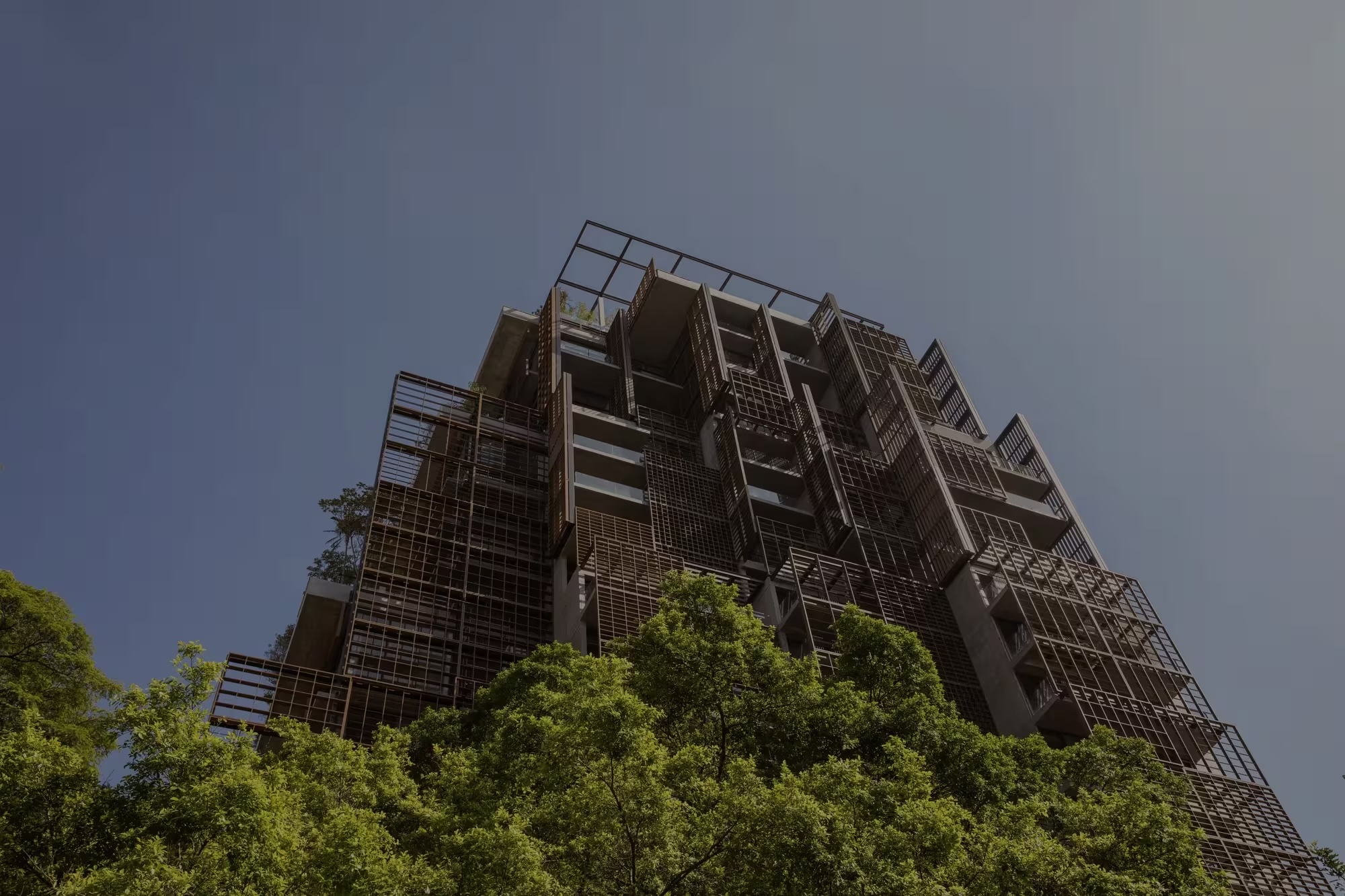
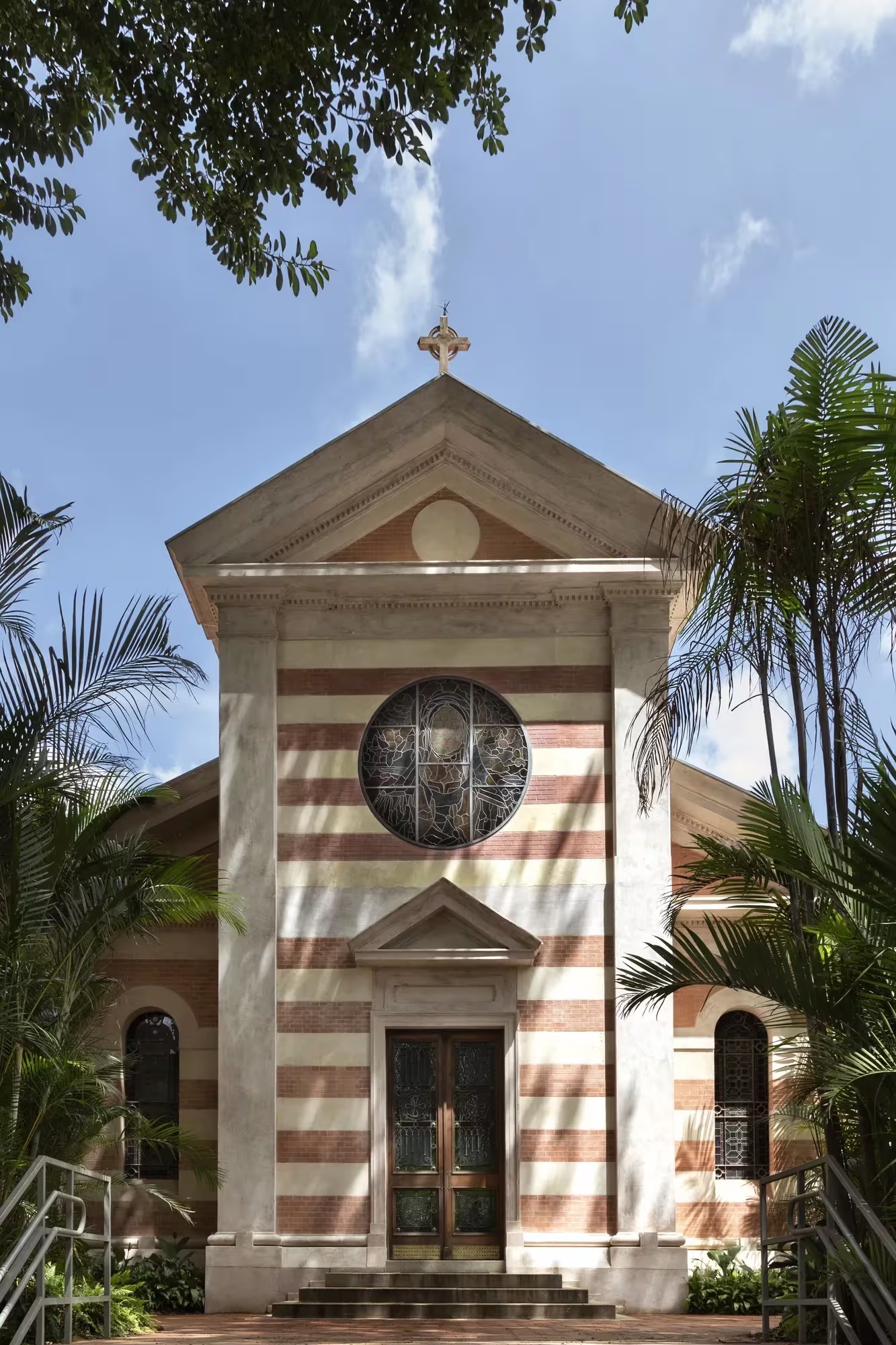
Twenty years later, that vision has materialized as Cidade Matarazzo—a 33,000-square-meter ecosystem in the heart of São Paulo that functions less like a real estate development and more like a living argument against separation.
Allard does not talk like a developer. He talks like someone who has studied how systems change and concluded that force never works.
"How do we make it right?" he asks. "The only answer I have is listen to your heart. It's a vibration machine and it's vibrating just as nature is vibrating. And if you understand that, that's it. The rest comes in very handy."
What he is creating, he says plainly, is a temple.
"Human beings, since we have something about our own history, have been creating temples. The temple is the solution. It's a place where we worship something. And the fact of worshiping is where we help our mind meet our conscience."
But this temple must do something religions sometimes fail at: it must seduce.
"It has to be fucking attractive," Allard says. "We create desire. People want to go to the temple. Think for one second how we build these extraordinary cathedrals at moments where we didn't have any money. People were starving and we were creating these gigantic things. Inside there, you had amazing artists coming and making these extraordinary paintings. The only thing they wanted to be is astounding, attractive. It was with beauty that they were trying to talk to our heart."
Nature, he argues, operates the same way. "Nature is about beauty. Nature never tells you it has to be ugly. You have to have a shitty car. You have to eat everything in cardboard that looks like dead earth. Nature brings flowers. It wants to seduce you. The mango has to be smelling amazing. The color has to be fantastic."
This is where Allard parts ways with conventional environmentalism.
"It is completely counter culture when it comes to ecology, because ecology wants to be ugly. Ecology wants to be a sacrifice. Ecology wants to be boring, wants to be numbers, wants to be people threatening us. I believe that we have nothing to do with ecology. We have everything to do with nature, which is completely different. And nature is beauty. Nature is interaction. Everything is linked. Everything adds sums, nothing divides."
Others have built sanctuaries. Bernardo Paz created Inhotim, the extraordinary art-and-nature reserve in rural Minas Gerais that Allard openly admires. But Allard chose a different battlefield.
"Eighty percent of the carbon emissions of our planet, 90% of the anxiety, the illness of our planet is generated inside cities," he says. "So the cities are responsible for almost all the problems we have as human beings. We need to cure the problem at the heart."
The logic is unassailable but brutal in its implications. "We know anyway, it's a movement that we cannot fight. There are billions of people who are moving into cities in the next 25 years. It's not the reverse. So we have to deal with the problem where it is and have the courage to face it at whatever cost."
Cidade Matarazzo sits on land that was abandoned for 20 years—the largest available site in São Paulo, untouched because every developer who looked at it concluded there was nothing to be done. Allard saw opportunity: "I wanted to prove that by recycling buildings, we would not only create value, we would create the most valuable asset in the whole country."
He did. Today, Cidade Matarazzo holds some of Brazil's highest real estate values—not despite its regenerative approach, but because of it.
"This is something absolutely nobody wanted to touch," Allard says. "And then I took it to the place where it's the best of the best and the most valuable in the country. It's the two absolute extremes. And how? Just with this thing and believing in nature."
The project functions as what Allard calls "an antivirus"—a deliberately infectious model designed to spread through desire rather than regulation.
"We contaminate people," he says. "Our place is made to receive 20 million visitors. So I can have every year the entire São Paulo will come and be contaminated by what I do. Although it's small, it's a giant project in the center of a city. But it's a church that can receive all the people of São Paulo and I can change the people of São Paulo."
The contamination happens through what he calls "biomas"—not verticals (a term he rejects as patriarchal) but interconnected ecosystems that mirror nature's integration.
Take food. Cidade Matarazzo works with 1,200 small-scale agricultores—farmers with less than one hectare—supplying restaurants and an organic market being built into reclaimed streets. "We create a platform for millions of people to create this new world," Allard explains. The permaculture market, he says, will be the largest in the world, fed by a supply chain that regenerates soil while building economic dignity.
The model extends to every dimension of the project: health, culture, design, fashion, hospitality. Each bioma is designed to prove that regenerative approaches generate prosperity.
"I didn't want to make something nice for the goofy green guys," Allard says. "I wanted to show guys there's money there so that people come, bankers come, investors come and say, let's use our existing global business models and put our ideology on the side. Let's make people make money doing that. And when you can prove that, then it becomes exponential."
The financial proof arrives through AYA Earth Partners, Cidade Matarazzo's business accelerator—Brazil's largest ecosystem dedicated to regenerative and low-carbon economies.
AYA houses 170 companies, but Allard refuses to work with sustainability officers. "I want to see the CEOs. I'm not interested in the head of sustainability, which is an ex marketing person who now knows how to express the talk but doesn't know how to work it because he doesn't have the checkbook."
The conversation with CEOs is blunt: transformation is survival, and delay compounds cost.
"There's a cost to change that has an inflation that is so high that four years from now, you're not going to be able to afford it," Allard tells them. "So you need to get started now."
Then he shows them the opportunity. Take iFood, Brazil's delivery giant—a company that could easily be framed as extractive, putting low-wage workers on motorbikes into polluted streets. Allard helped them rethink the entire system: electric fleets, renewable packaging made from mushrooms or babassu, workforce incentives aligned with purpose.
"Better results, more efficiency, purpose-driven company, people who stay more in the company, more loyalty, clients that love the process because it talks to their heart and not to their brain and has financial success," Allard says. "It's fantastic."
The work extends to giants like Vale, the world's largest mining company, and luxury conglomerates like LVMH. "We oblige them if they want to be with us and we have the clients—if they want me to give my clients to them, they have to make some steps. And then we show them that every step is generating money."
The clearest proof is visible: Rosewood São Paulo, designed by Jean Nouvel with interiors by Philippe Starck, opened as the first luxury hotel built entirely on regenerative principles.
"Nobody would ever believe that making a green luxury hotel would ever work," Allard says. "Now I did it. And now guys like Rosewood, they only talk about this. This is what they call generation three hotel."
The results? "The best result ever in the history of Latin America. We are the most expensive hotel. People's level of satisfaction is extraordinary, our restaurants are all full."
Real estate followed the same trajectory. "Our apartments are the most expensive in the history of Brazil on the wrong side of Paulista. It's like you say Tribeca now is more expensive than having an apartment on the Upper East Side. Why is that? Because we are so strong in what we do and we believe so much in what we do."
Richard Branson, visiting for a planetary guardians gathering, spent three days in AYA's meeting rooms. His public comment: "I've never in my life been so attached to a place like this one. And this place only alone is conveying the message and the energy that becomes the platform for our dreams to become true."
The building itself does work that no virtual platform could replicate.
"We use the capacities, the vibrational capacity of the most talented architects and designers in the planet to express something and all together in their differences, they say something that already prepares you," Allard explains. "You're prepared, you're ready. We open this little box in your brain which says, let's make your heart talk because it's fucking beautiful."
The sticky factor is measurable. Companies organizing events at Cidade Matarazzo see 80% attendance compared to 5% elsewhere. Good programs get 150% attendance—people show up uninvited because they want to be in the space.
"It's unexplainable. You can't pay for it. Money can't buy that. And that's the vibration. That's the beauty. We're like nature. We're attracting people because our aim is good. It's about survival of our humanity and you can feel it in every place."
The model is already replicating. Cidade Matarazzo's success convinced São Paulo to change citywide laws, offering tax incentives for retrofit over demolition—a policy shift Allard helped design but from which he never benefited.
"I have never benefited from that," he says. "But I worked with five mayors as advisor. I put this in place for the others."
In 2025, the MATA concept expanded to Rio de Janeiro's historic port district—223,000 square meters that will become native forest, AI-enabled green towers, and the largest urban park on Guanabara Bay. Projects are planned in Doha, Albania, and other global locations.
Within São Paulo, the ambition is to transform the entire Paulista corridor. "Give me 20 years from now around Matarazzo, you will have a forest of kilometers. We will close down Paulista. We will transform it into a forest."
The ecosystem already manages surrounding parks. A new permaculture market is breaking down streets to create what Allard calls "the largest permaculture market in the world," positioned where one million people pass daily.
"We contaminate both physically and mentally and consciously all the people," he says. "And if I can do that in some place with all that it represents—this super heaviness of extraction—I can do it anywhere in the world. And mostly in the global South, because the future of our planet is not in the North, it's in the global South."
The lesson Allard offers is clear: stop asking people to sacrifice. Stop building green projects that look like penance. Build temples that seduce through beauty and prove through profit.
"This is not constraint. This is not an issue. This is not something you need to comply with because you have shareholders or electors or your children who say you are fucking old style people," he says. "This is because it's good for you and you're going to love it. And it's going to generate prosperity."
The paradox he has proven: the most radical transformation comes not from retreat to rural sanctuaries but from building oases inside the machine itself. Cidade Matarazzo sits in the heart of extractive urbanism—and generates the city's highest real estate values precisely because it operates by different rules.
Systems change when their inputs change. The input Allard has altered is desire itself. He is not asking people to choose regeneration over prosperity. He is proving they are the same thing—that alignment with nature's patterns generates the prosperity our current systems promise but cannot deliver.
"We are all in transition," he says. "Where we are in the transition is where we are on this path. Maybe I'm a very advanced guy. I'm only 5% into the path. And a not advanced guy is at 0%. But I still have 95% to complete, so I'm not so far away."
The temple he has built is not the destination. It is the portal—a physical demonstration that another world is possible, and that entering it requires not sacrifice but desire, not constraint but beauty, not separation but belonging.
By 3,800 employees. Twenty million visitors projected annually. One hundred and seventy companies learning to operate differently. And spreading—to Rio, to other cities, to other continents—not through regulation but through infection.
An anti-virus, released into the system.
The Anti-Virus: Building Temples of Transition in the Heart of Extraction
Listening to the landscape, learning from nature